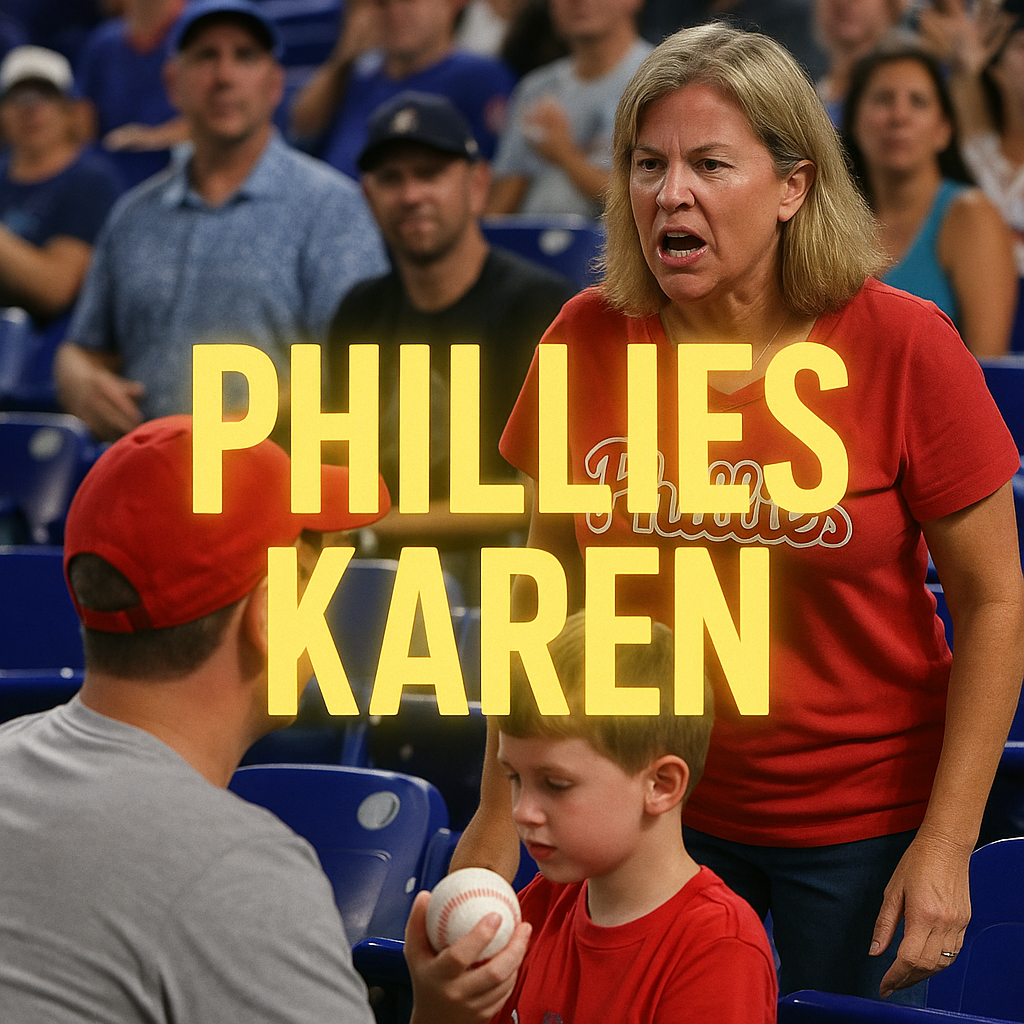
Baseball is often called America’s pastime — a sport where families bond, children dream, and legends are made with a single swing. But on September 5, 2025, at the Phillies vs. Marlins game, the magic of a home run turned into a viral controversy. A woman, now infamously nicknamed “Phillies Karen”, became the center of outrage after she snatched a prized baseball from a young boy celebrating his birthday. The internet erupted, news outlets picked up the story, and debates about fan etiquette and kindness in sports began trending worldwide.
This is the full story of who Phillies Karen is, what really happened that night, and how a negative moment transformed into an unforgettable act of redemption.
The Home Run That Sparked It All
The Phillies were battling the Marlins in Miami when Harrison Bader sent a baseball flying into the crowd. For fans, catching a home run ball is a bucket-list moment — but for one young fan named Lincoln, it was about to become the highlight of his birthday.
Lincoln’s father caught the ball and immediately handed it to his son, making the boy beam with joy. Cameras captured the heartwarming moment — but it didn’t last long. Within seconds, a woman from a nearby seat marched over, insisting the ball was hers. She demanded it back, raising her voice, and confronting the father in front of stunned fans.
The tension spread across the section. The crowd, visibly shocked, started chanting: “Karen! Karen!” The name stuck instantly, and within hours, the world would know her as Phillies Karen.
Who Exactly Is “Phillies Karen”?
The internet thrives on villains and heroes, and Phillies Karen quickly became the villain of the night. Clips of her confrontation circulated on X (formerly Twitter), Instagram, and TikTok, racking up millions of views. Memes poured in, showing her compared to other infamous “Karens” — a slang term used for entitled or rude behavior in public.
Speculation about her real identity began almost immediately. Some users claimed she was Cheryl Richardson Wagner, a woman from New Jersey. Others alleged she worked in the local school system. But these claims were quickly debunked.
- Cheryl Wagner herself spoke out, denying any involvement and clarifying she had been wrongly accused.
- The Hammonton Public School District released an official statement confirming that Wagner was never employed with them and that the circulating rumors were false.
This misinformation showed how quickly online “sleuthing” can spiral out of control. In reality, the woman’s true identity has not been publicly confirmed. What remains is the viral nickname: Phillies Karen.
The Backlash and Public Outrage
Sports are emotional, but fans felt there was an unspoken rule broken that night: if a kid gets a ball, let them have it. Instead, Phillies Karen was seen as the adult who ruined a child’s birthday memory.
Broadcasters, including ESPN’s SportsCenter, criticized her on live television. Talk shows and podcasts mocked her behavior. Social media platforms turned her into the face of poor sportsmanship.
Some of the common reactions online included:
- “Imagine stealing joy from a little boy on his birthday. That’s Phillies Karen for you.”
- “She’ll forever be remembered for 30 seconds of entitlement.”
- “The internet doesn’t forget, and neither will that kid.”
It wasn’t just about one baseball anymore — it became a symbol of kindness versus entitlement.
The Redemption Arc – Kindness Restores the Game
As boos and chants echoed around the stadium, Marlins staff stepped in to comfort Lincoln. They gifted him a special goodie bag filled with team merchandise, trying to bring back his smile. But the best part of the night came later.
After the game, Phillies outfielder Harrison Bader personally met with Lincoln. In a touching gesture, he handed the boy a signed bat and a baseball, ensuring his birthday would be remembered for the right reasons.
Photos of Lincoln smiling with his new treasures quickly went viral. The narrative shifted: while Phillies Karen had brought negativity, the players and staff turned it into a story of sportsmanship and generosity.
Why This Story Went Viral
So why did the Phillies Karen incident spread so far, so fast? There are a few key reasons:
- Viral Outrage Culture – People love to react to shocking behavior, and the image of an adult snatching a ball from a child triggered instant empathy for the boy and anger toward the woman.
- Clear Villain vs. Hero Dynamic – Every story needs roles. Phillies Karen became the villain, while Lincoln and Bader emerged as heroes.
- Video Evidence – The incident was caught on camera, making it easy to share, remix, and meme.
- Sports as a Global Stage – Baseball may be American, but viral content transcends borders. Fans worldwide tuned in to debate etiquette at games.
The Identity Confusion – Internet Sleuthing Gone Wrong
Perhaps the most troubling part of the story is how quickly the internet tried to “unmask” Phillies Karen. False names and accusations spread online like wildfire. Innocent people, like Cheryl Wagner, were suddenly dragged into the drama, receiving messages and online harassment.
This raises a broader question: is viral justice always fair? While Phillies Karen’s behavior may have deserved criticism, falsely accusing someone else shows the darker side of cancel culture.
What This Incident Teaches Us
The Phillies Karen saga is more than just a funny internet meme. It reflects larger truths about human behavior and modern society:
- Sportsmanship matters: Fans should remember that games are about joy, especially for kids.
- Kindness wins: Harrison Bader’s small act of kindness did more for baseball’s image than any home run that night.
- The internet is powerful and dangerous: Viral fame can destroy reputations, even when based on false information.
- Moments define us: Phillies Karen will forever be remembered for that 30-second outburst, proving how one decision can leave a lasting mark.
Phillies Karen may never have her real name known, but her actions became a global talking point overnight. From the shocking moment of entitlement to the heartwarming redemption provided by Harrison Bader and the Marlins staff, the story touched millions.
In the end, it wasn’t about a baseball. It was about what we value in life — entitlement or empathy, selfishness or kindness. For Lincoln, the birthday boy, it became a tale he’ll cherish forever: the night he not only got a signed bat from a professional player but also showed the world that good can triumph over bad.
And for the rest of us, it’s a reminder: in sports and in life, let the kids have their moment.