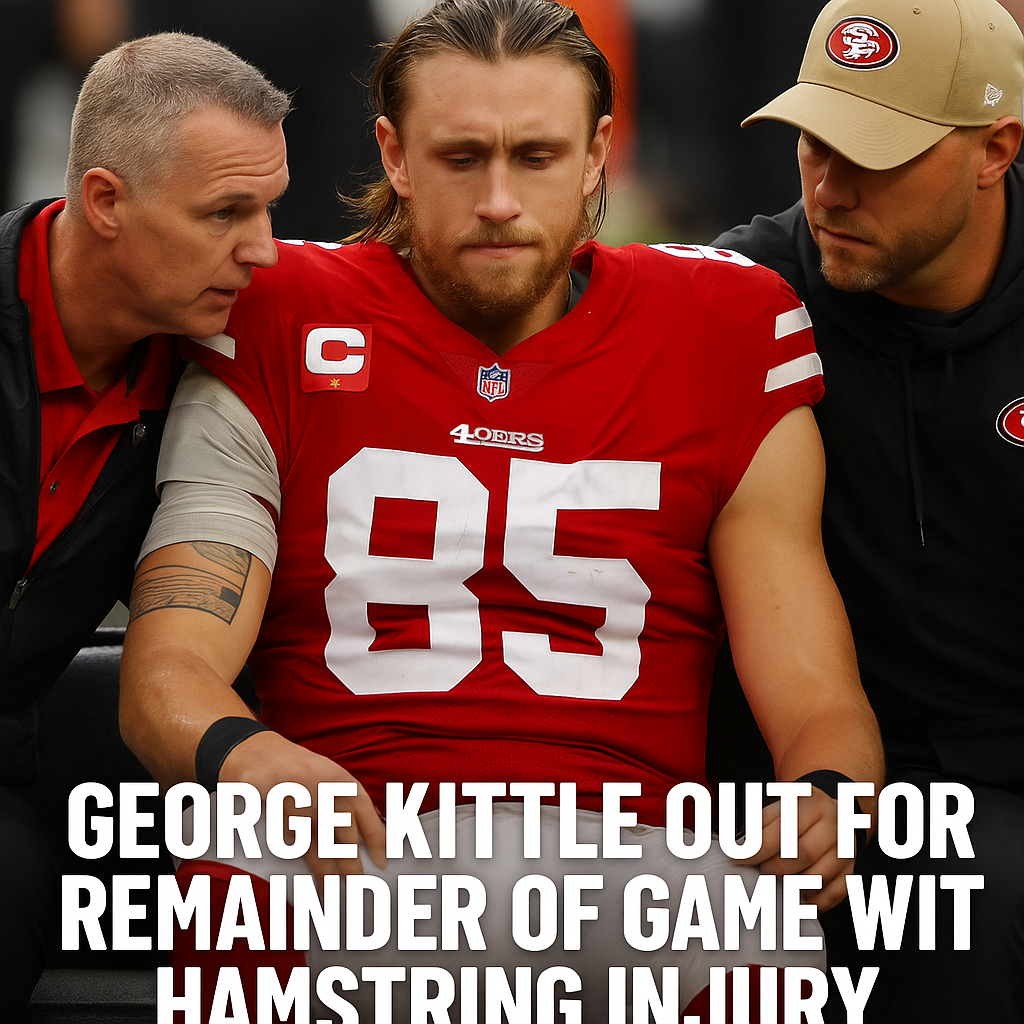
In a dramatic early blow for the San Francisco 49ers, star tight end George Kittle exited Sunday’s season opener against the Seattle Seahawks with a hamstring injury and did not return, raising serious concerns about his availability in the weeks ahead.
It was shaping up to be a perfect start to the season for the standout tight end. Kittle made his presence felt immediately, hauling in four receptions for 25 yards, including a 5-yard touchdown that capped the 49ers’ opening 14-play, 95-yard drive. The score, delivered on a third-and-goal, put the Niners up 7–0 early in the first quarter
However, on a second-and-22 running play, Kittle attempted to block downfield for Christian McCaffrey, only to suffer what appeared to be a hamstring injury during the effort. He limped off the field, signaling for help, and promptly entered the medical tent. When he emerged—without a helmet and wearing a baseball cap—it became clear he would not return; less than a drive later, the team officially ruled him out for the remainder of the game.
Kittle’s Importance—and the Niners’ Loss
This isn’t just any loss. Kittle is more than a tight end—he’s a foundational piece of the 49ers’ offense. A two-time First-Team All-Pro and multi-year Pro Bowler, he posted another monster season in 2024 with 78 catches, 1,106 receiving yards, and eight touchdowns, earning Second-Team All-Pro honors.
His absence today creates a vacuum. While 49ers fans have seen injuries before—just last season, the team struggled amid frequent absences—losing such a dynamic weapon in Week 1 immediately raises alarms about offensive continuity and health management.
In Kittle’s place, the 49ers will lean on Luke Farrell, their most notable free-agent addition of the offseason. Primarily known as a blocking tight end, Farrell brings limited pass-catching upside—he totaled just 36 receptions for 318 yards over four seasons and had 12 catches for 67 yards with the Jaguars last year.
Fullback Kyle Jusczyk, another reliable target, will also likely see an expanded role, but neither represents a replacement for Kittle’s elite blend of blocking, route-running, and YAC (yards after catch) ability.
Meanwhile, other pass-catchers, including Jauan Jennings, Ricky Pearsall, and Marquez Valdes-Scantling, will be under pressure to step up—especially in an offense already missing Deebo Samuel and dealing with a hobbled Christian McCaffrey this week.
What’s Next? How Serious Is the Injury?
Details on the severity of the hamstring injury are not yet known. The speed with which Kittle was ruled out signals at least a moderate strain— Grade 1 injuries can sideline a player for about a week, while Grade 2 or 3 can cost several weeks or the remainder of the season or even require surgery.
What’s clear is that the 49ers can’t afford a prolonged absence for Kittle. Coming off a 6–11 season, the team desperately needs to start strong and maintain health to maximize this roster’s ceiling.
George Kittle’s departure was a shock—mirroring the worst fears of fans and analysts across the Bay Area. As a cornerstone of the 49ers’ offense, his absence today narrows the margin for error and challenges the team’s depth. Yet, with a resilient roster and creative coordinator, San Francisco may still find ways to adapt in Kittle’s stead. What remains unclear—but critically important—is how long he’ll be sidelined and whether his loss becomes a ripple or a ripple turned wave.