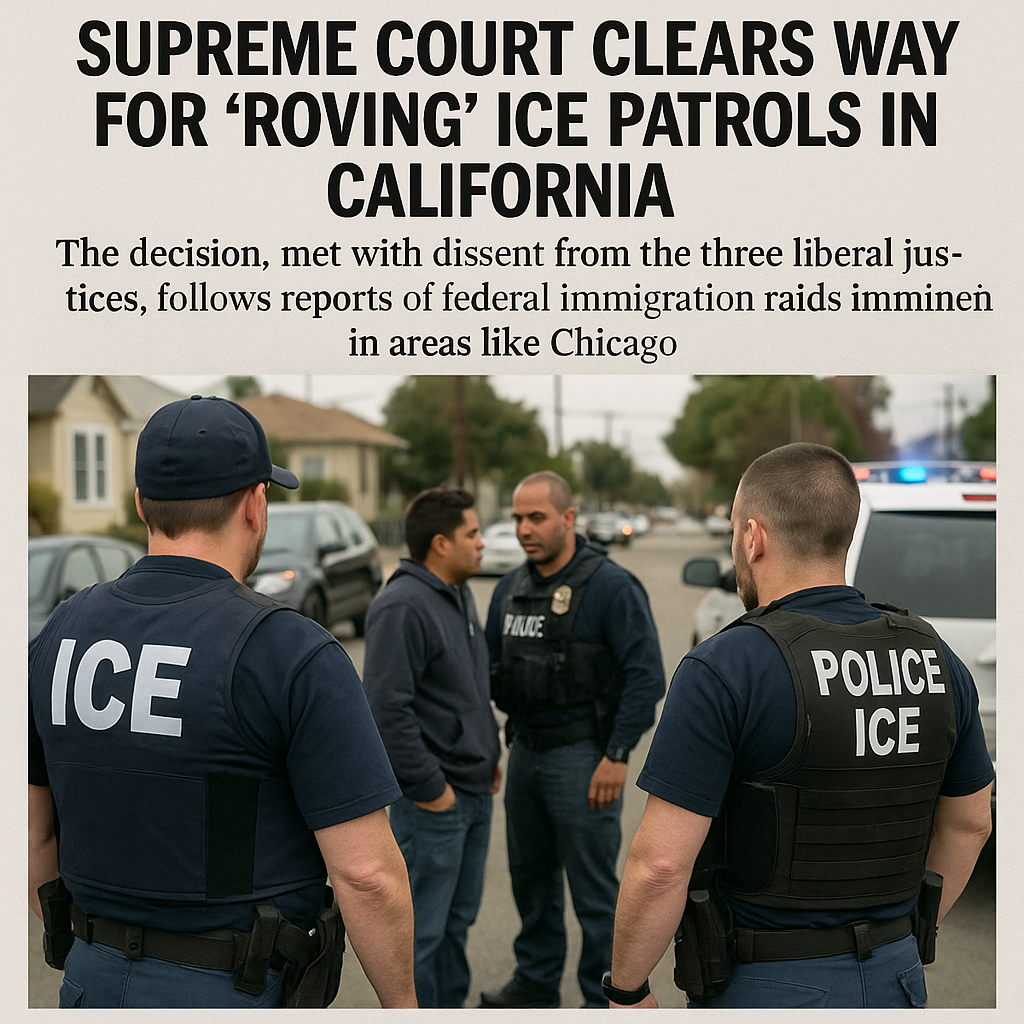
Washington, D.C. – September 8, 2025 – In a striking development, the U.S. Supreme Court effectively lifted judicial restrictions preventing Immigration and Customs Enforcement (ICE) from conducting “roving” patrols in Southern California. In a 6–3 decision issued via a brief, unsigned order, the Court granted the Trump administration’s emergency request to pause a lower court’s temporary restraining order while litigation continues. The ruling opens the door for renewed immigration enforcement operations in heavily Latino communities, including Los Angeles, even as the case moves forward—drawing sharp dissents from the liberal justices.
In July, U.S. District Judge Maame Ewusi-Mensah Frimpong issued a temporary restraining order (TRO) barring ICE from conducting stops based solely on race, language, job, or location—factors frequently used in “roving” operations targeting Latino individuals at sites such as carwashes, bus stops, and workplaces. The injunction was prompted by mounting evidence that noncitizens and even U.S. citizens had been detained without individualized reasonable suspicion, raising serious Fourth Amendment concerns.
SUPREME COURT ORDERS – Without providing a detailed explanation—a common approach for emergency matters—the Supreme Court lifted the TRO, enabling ICE agents to resume aggressive patrols in Los Angeles and surrounding areas.
Justice Brett Kavanaugh, a Trump appointee, concurred with the majority’s emergency relief, arguing that federal immigration enforcement has long permitted stops based on reasonable suspicion—and that demographic factors can play a relevant role when combined with other credible indicators. He emphasized: “Apparent ethnicity alone cannot furnish reasonable suspicion; under this Court’s case law, however, it can be a ‘relevant factor’ when considered along with other salient factors.”
Kavanaugh further assured that individuals lawfully present in the U.S. would be released following a brief interrogation: “If the person is a U.S. citizen or otherwise lawfully in the United States, that individual will be free to go after the brief encounter.”
The three liberal justices—Sonia Sotomayor, Elena Kagan, and Ketanji Brown Jackson—issued a forceful dissent condemning the ruling. In her dissent, Justice Sotomayor decried the decision as: “Unconscionably irreconcilable with our nation’s constitutional guarantees.”
She warned of a return to discriminatory policing: “We should not have to live in a country where the Government can seize anyone who looks Latino, speaks Spanish, and appears to work a low wage job.”
Sotomayor further challenged Kavanaugh’s assurances, noting that on-the-ground enforcement often involves force, warehouse-like detentions, and the separation of individuals from their jobs—practices that belie the notion of “brief stops for questioning.” Her dissent acknowledged that U.S. citizens have been caught up in these raids and warned of the erosion of constitutional protections for entire communities.
The Supreme Court’s emergency decision does not resolve the underlying case, which will proceed through the lower courts. Hearings on a preliminary injunction are expected later this month in the federal district court.
The ruling marks a significant win for the Trump administration’s aggressive immigration enforcement strategy—fulfilling its second-term promise of mass deportations—even as it invites deeper scrutiny over constitutional implications and potential profiling.
All together conclusion is The Supreme Court’s action on September 8, 2025, reinstates controversial “roving” ICE patrols in Southern California by temporarily overriding a lower court’s limitation on enforcement tactics. The decision, backed by a brief, unsigned order and a concurrence from Justice Kavanaugh, permits the continued use of broad demographic indicators—language, occupation, appearance—as part of reasonable suspicion. The three liberal justices strongly dissented, warning of unchecked racial profiling, Fourth Amendment violations, and harm to U.S. citizens. As the case unfolds in federal court, this emergency ruling underscores high-stakes legal battles over immigration policy, civil liberties, and executive power.